Send us your questions

Some of our visitors have sent emails with interesting questions, we decided to start having a space to answer them. In this space the blog "Restless Minds" will answer all questions you send us
Send us your question for the email: Restless Minds.

Science progress affects our daily life and "to know" means you are going to chose right, because it allows you to form your own opinion on scientific everyday issues. On the other hand, having an elegant and harmonious vision of the world where we live in leads to a feeling of intellectual satisfaction.
We believe this kind of scientific day to day knowledge should be encouraged from an early age, and that's why this project was born: science, culture, knowledge, crafts for your restless mind.
Showing posts with label chemistry. Show all posts

Saturday, May 4, 2013

Emulsion, oil/ water coloring droplets

Cleaning the fryer back home is not exactly easy. Who usually does this knows that is a messy, sticky and dirty work. To minimize this greasy effect we usually fill the fryer with boiling water and add detergent on a very generous amount. In fact I usually pre wash all the dishes before putting them in the machine. Why? Because it allows the fat to dissolve in the water and not inside the machine or in my hands.

Why?
Because the detergent is an emulsifier, and as such promotes the formation of emulsions.
An emulsion is a system consisting of two immiscible liquid phases (oil and water). We may have emulsions of oil in water (O / W: external aqueous phase) and water in oil (W / O: oily external phase).
The emulsion stability is ensured with use of emulsifying agents such as detergent, surface-active substances generally.

We will need:
  • 3 transparent cups, glass or plastic,
  • water, enough to fill two cups,
  • cooking oil,
  • food coloring,
  • pencils.
How to:
  1. Fill one of the containers with water (2/3) and the other with the same amount of cooking oil;
  2. Add 3-5 drops of food coloring to each, leave some space between the drops so that they do not touch each other;
  3. What happens?
  4. Fill the third container with water up to 2/3, add some oil, enough to form a layer on top of the water.
  5. Add the food coloring the same way as in the previous point. Try to predict what will happen;
  6. What happens?
  7. With the sharp pencil touch a droplet of colorant of the third cup;
What happens?
When the food coloring is added to water, it blends completely with it. When you add the same food coloring to the oil, a small sphere is formed on oil surface.

Why?
Water molecules are polar, in other words they have a small positive charge at one end and a small negative charge at the other, for this reason they remain together, by forming hydrogen bridges. Unlike water molecules, the oil molecules are non-polar - have no charge-, for this reason, the molecules of oil also tend to stick together.

When we "force" an oil to mix with a water based solution (the food coloring) those form an emulsion.

A emulsifier it's a molecule with to different ends, one that loves water (hydrophilic) and a second that hates water (hydrophobic). Imagine a wood stick with two ends, one of them "sinks" in the oil- the hydrophobic end- the other in the water- hydrophilic end. This phenomena is responsible for the formation of small oil droplets -spheres- in the water. This is a stable structure and it's what we call emulsion, many things around us at home are emulsions like mayonnaise and face creams, for example.
If you try to mix the jar 3 emulsion you will verify that after a while the oil will came back to the top..

When you use food coloring (FC), what happens is that the FC droplets drag a small amount of oil with them as a "coat", that's why the FC stop in the oil. the oil acts as a life saver coat, preventing the droplets to drawn. When you punch the droplets with the sharp pencil, the "oil coat" is broken and the FC- a water based solution- blends, almost immediately, with the water bellow the oil. 

Go further
If you want to go further change the variables, one at time and take notes.
  • Use different kitchen oil types;
  • Use vinegar or any other kitchen liquid instead of FC.

Et voilá!
Now you can avoid your daily bath: "Mom I'm hydrophobic!"

Enjoy!

Saturday, April 6, 2013

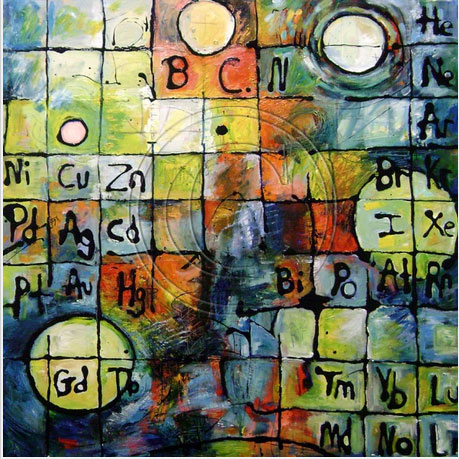
Princess Rashid- Art with science


I found Princess Simpson Rashid while I was googling in Internet about the Periodic Table of chemical elements, her paintings just popped up when I asked google to see "images".  My first thought was "wooo this is soberb, I have to post this". I found it so amazing that, for the first time in "Mentes Irrequietas/ Restless Minds Boosters" blog history, I felt I should write the artist before I post it, and so I did it, Princess Simpson Rashid answered me next day giving Restless Minds permission to post her work, thats why for the first time- of many more, I hope- the image has the "used with permission" statement.

Princess Simpson Rashid is a passionate with science. She is a Bachelor in Physics- Georgia State University-, and she studied printmaking and painting at the Escuela de Artes Plastica in San Juan, Puerto Rico.

Science-Inspired Abstraction, Modern Sport-Fencing, and Expresssionistic Landscapes are the main themes she turns to in her work. Today we are going to see only a small part of her work, the Science-Inspired Abstraction.
If you like the images you are going to see next, I strongly advise you to check Rashid website, her work is "super restless" and full of color and good energy.
At this moment Rashid lives in Tampa, Florida, USA, and in her own words:

"My current body of work explores the relationship between abstract art and math, color and music, composition and perception. I use line and color to convey movement. My painting technique often involves dripping and pouring paint until I’m satisfied with the composition. My artistic goal is to capture the individual energy and essence of the subject matter by whatever means available to me. Color, texture, design and energy are the components that make up all of my work.." in http://www.foglefineart.com/artists/profile/rashid-princess/

In this paintings Princess Simpson Rashid is a true art scientist, or "sciencartist" if you want, she uses the elements of Periodic Table, the x's and y's from math and even Pi constant from geometry (the famous 3,14). Super Restless uh?

©Princess Simpson Rashid, "Periodic Table-2",  Acrylic on Canvas, 36 x 60 inches. www.princessrashid.com Used with permission.

©Princess Simpson Rashid, "Periodic Circles 2",  Acrylic on Canvas, 36 x 36 inches. www.princessrashid.com Used with permission.

©Princess Simpson Rashid, "Composition B",  Acrylic on Canvas,48 x 24 inches. www.princessrashid.com Used with permission.

©Princess Simpson Rashid, "Composition A",  Acrylic on Canvas,48 x 24 inches. www.princessrashid.com Used with permission.

©Princess Simpson Rashid, "Periodic Circles 1",  Acrylic on Canvas, 36 x 36 inches. www.princessrashid.com Used with permission.

©Princess Simpson Rashid, "Pi-1",  Acrylic on Panel, 24 x 24 inches. www.princessrashid.com Used with permission.

For more informations please consult Rashid website, and her blog.

Sources: 
http://www.foglefineart.com 
http://princessrashid.com

Et voilá!
Science and art holding hands!

Enjoy!
Related Posts Plugin for WordPress, Blogger...